Forward Deployed Engineer: What They Do, When You Need One
A forward deployed engineer is embedded with one customer to build in their real systems. See what the role solves, what it leaves alone and how to decide.
Read More


Hiring remote developers in Ecuador means bringing an engineer who lives in Ecuador into a team based elsewhere, working the same hours as that team and under its direction, while the employment itself stays in Ecuador. For North American companies, it is a way into Latin America's talent pool that many overlook: a country that keeps New York's clock in winter and Chicago's in summer, with a tech sector that keeps gaining weight in its economy.
Ecuador rarely makes the first shortlist, which is usually limited to the region's largest economies. That is exactly why it deserves a look when a role has been open too long. This guide covers the local tech industry, the advantages and limits of Ecuadorian developers, what a position costs in total, and how to hire, step by step.
Ecuador's software industry is growing, increasingly export-oriented and concentrated in a few cities. Quito and Guayaquil are its two main centers, home to most of the country's tech companies, startups and IT programs. Quito concentrates public institutions, universities and a growing startup scene; Guayaquil, Ecuador's main port and commercial center, adds companies in trade, logistics and finance.
Public programs have supported the sector by expanding internet access, strengthening IT education and backing digital entrepreneurship. Those efforts have helped create small but active tech hubs, as cities that once depended on traditional economic activities shift toward services and technology.
For North American companies, the attraction is practical: Ecuador shares working hours with the East Coast and has a growing pool of developers used to international clients. Real-time collaboration replaces the overnight handoffs of offshore models.
Ecuador is a strong option for software development talent because it combines Eastern-time working hours, a growing number of IT graduates and a tech market that is still less contested than the region's largest ones. For a hiring company, that means reaching good developers without competing against every foreign employer at once.
Mainland Ecuador runs on UTC-5 all year and does not observe daylight saving time. It shares the clock with New York during US standard time and sits one hour behind it when the US moves to daylight saving time. When you hire developers in Ecuador, your team shares most of its working day with them, which makes code reviews, standups and fast decisions possible without anyone working at night.
Computer science, systems engineering and related programs are a common path for students responding to local and international demand for developers. As more companies recruit Ecuadorian developers, more students choose those careers, and the pool keeps widening.
Ecuador's IT services sector has benefited from the wider move of North American companies toward Latin American talent. Government initiatives to improve digital infrastructure and connectivity have supported that growth, and the shift to remote work after the pandemic made Ecuadorian developers visible to employers who had never considered the country before.
Ecuadorian universities and technical institutes have been updating their programs to international standards, especially in systems engineering and computer science. For anyone looking to hire LATAM developers, a growing and better-trained pool means more mid-level and senior candidates to choose from.
The roles hardest to fill today are in AI engineering, data and security, and Ecuador's developers are following the same shift as the rest of the industry. In the 2025 Stack Overflow Developer Survey, 84% of respondents said they use or plan to use AI tools in their development process. When you interview, separate two skills: building AI into real systems, and working safely with AI coding tools. Ask for a concrete example of each. The guide to hiring AI developers in Latin America covers what to look for.
Every model that touches your data widens the surface someone has to protect. Developers who understand data pipelines, data quality and access control, and who ask what a tool may read before connecting it, are worth more than their job title suggests. For roles close to production data, make this part of the technical assessment.
For companies in North America, the shared working day is the most immediate benefit. It makes agile practices workable across borders and is especially valuable for projects that need frequent updates and close cooperation between teams.
Ecuadorian professionals are known for their work ethic, adaptability and familiarity with North American business practices. Those traits support clear communication and smooth teamwork in projects that involve people in several countries.
Public investment in digital infrastructure, internet access and tech education has created a more stable environment for technology work, which makes long-term engagements with Ecuadorian developers easier to plan.
[IMG alt='EF English Proficiency Index results for Ecuador']
Ecuador ranks 83rd globally in the latest EF English Proficiency Index, with a score of 466, below the global average of 488. National averages hide large differences, though: many IT professionals work daily in English with international clients, and bilingual education is expanding. For roles with heavy client contact, test English in the interview rather than assuming it from the country score.
Hiring remote developers from Ecuador generally fits a smaller budget than hiring in-house developers in North America, thanks to lower local salaries and living costs and a dollarized economy that removes exchange-rate risk. Here is what a full year of salary can look like by level:
Keep in mind that these rates can be 20-30% higher when working with a specialized staffing agency. [DATO POR CONFIRMAR: fuente de los rangos y del 20-30%.]
The salary is only the starting point. The total cost of a position also includes employment costs in Ecuador, the time your team spends interviewing and onboarding, the tools the developer needs and, if the team works with AI, the cost of those tools and their tokens. A partner's higher rate usually covers part of that: finding the person, employing them and replacing them if it does not work out. Compare the full cost of each option, including the cost of the role staying open while the search runs.
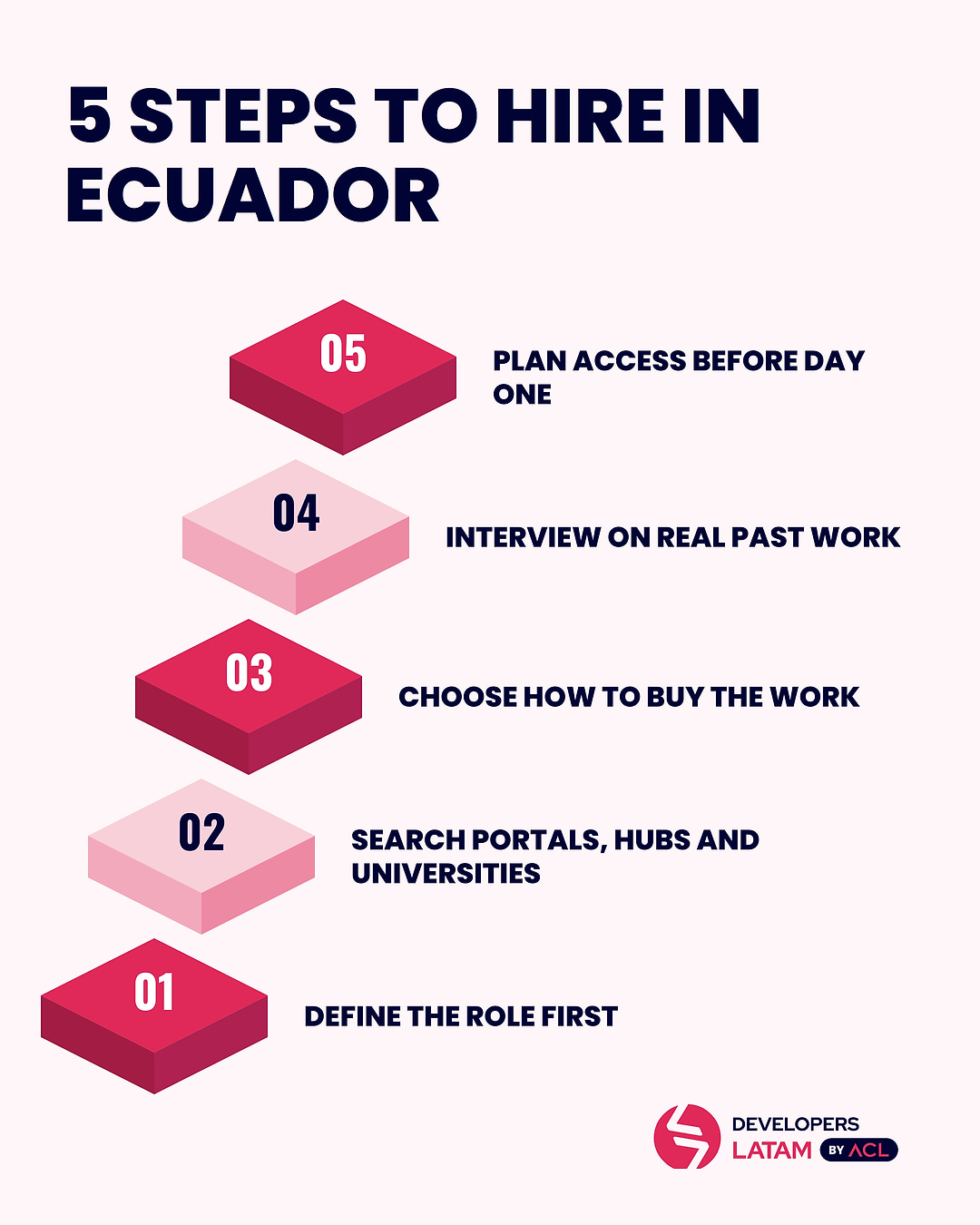
Write down what the role has to do, what it integrates with, who it reports to and what success looks like in six months. That brief sharpens every channel and every interview that follows.
Ecuador's developers work across mainstream languages such as JavaScript and Python and in more specialized technologies. Understanding the depth of the local talent pool, and the tech culture in Quito and Guayaquil, helps you evaluate candidates' skills and fit during interviews.
Local job portals such as Multitrabajos and global networks such as LinkedIn are where Ecuadorian professionals look for new roles. They give you a wide range of candidates, at the cost of more screening work on your side.
Universities and tech communities in Quito and Guayaquil are a direct line to graduates and experienced professionals. Local meetups and conferences are good places to meet developers who are not actively looking. For the wider process of building a remote development team, the same principles apply across countries.
DevLatam offers three ways in. The engineers and the employment model are the same in all three; what changes is how you buy and how the risk is shared.
Whichever way you choose, the employment question has a one-line answer: “We are their legal employer. Payroll, compliance and employment obligations sit with us, in the country where they live.” The page on who legally employs them explains what transfers and what stays with you.
If you work with a partner, ask for evidence rather than a list of specialties. Where have they placed this exact profile, and when? Who assessed the candidates technically, and how? What happens if the person does not work out, and who absorbs that cost? A partner that reaches scarce profiles in Ecuador can answer in writing.
A careful selection process checks technical skills, problem-solving, adaptability and fit with your team. Ask candidates to walk through something they actually built: what the constraint was, what they chose and what they would do differently. You interview whoever you want, and nobody joins your team without your yes.
Decide which repositories, environments and data the developer can reach, who reviews their first pull requests and what they should deliver in the first weeks. If the team uses AI tools, settle what the developer is allowed to point a model at. A clear first month turns a good hire into a productive one faster, and keeps the knowledge they build inside your systems.
No ranking settles which country has the best programmers, because the answer depends on the person, not the passport. What does change from country to country is the size of the pool for a given profile, the working hours and the English level. In Ecuador, the shared clock is a clear advantage, and English is worth testing.
Ecuador is a middle-income economy: the World Bank classifies it as upper middle income. For a hiring company, that helps explain why local salaries are lower than in the United States, while the dollarized economy removes exchange-rate risk from payroll. It says nothing about an individual developer's skill, which only the interview can measure.
The best company depends on what you want to buy. A job platform gives you candidates to screen, a recruiter gives you a shortlist, a staffing partner gives you an engineer it employs, and a managed services provider gives you a delivered result. Choose the model first, then compare providers on evidence they can put in writing.
Ecuador offers developers on your working hours, a growing talent pool and a tech scene that many hiring teams have not yet discovered. The hire works best when it starts from the role and the total cost, not from the salary. If the hard part is finding the person, see how to fill a position with an engineer who works under your direction, or talk to us about a position.
Learn more about nearshore software development by reading the articles from our blog!