Hiring LATAM Software Developers: Compliance & QA Guide
Avoid compliance gaps and quality issues when hiring LATAM developers. Actionable checklist for vetting talent, contracts, and cultural alignment.
Read More


For the modern C-suite, the technology challenge is no longer just hiring developers. It is building a scalable, resilient engineering function without absorbing the cost, delay, and management load of a large domestic department.
When a company does not already have an internal development team, even basic product maintenance can consume runway that should be funding innovation. In U.S. tech hubs, senior salaries can exceed $200,000, while retention remains volatile.
Traditional offshore models were created to solve the cost problem, but they often introduced a new one: operational drag.
Teams spread across South Asia or Eastern Europe can face long asynchronous gaps and communication delays that turn simple product questions into full-day blockers. Nearshoring to Latin America offers a different model. It combines cost efficiency with real-time collaboration, cultural fit, and access to engineers who can plug into modern delivery environments without slowing the roadmap.
Nearshore software outsourcing allows enterprises to reclaim product runway without sacrificing engineering quality.
Compared with North American hiring benchmarks, Latin American teams can produce realistic cost savings of 50% to 75%, depending on country, seniority, and engagement model. That capital difference gives leaders more options: extend the timeline, increase feature velocity, strengthen QA, or scale capacity within the same budget.
Executives should avoid treating LATAM as a single compensation market.
Data from the Global Developer Hiring Index indicates that baseline salaries can vary by up to 50% between major countries such as Brazil and Mexico, while internal differences between primary and secondary cities can swing by up to 20%. That variation makes country selection, hub selection, and compensation design critical to both hiring success and retention.
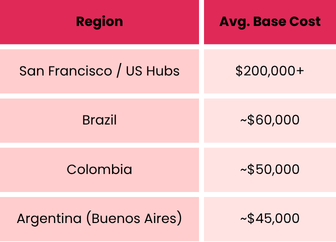
Those numbers are only the starting point. Local labor frameworks also matter. Argentina, for example, mandates Aguinaldo, a statutory 13th-month bonus split across the year.
Optimized independent contractor structures may reduce certain employment obligations while maintaining cross-border compliance, but the point is not to improvise. Leadership teams should use a data-driven LATAM salary calculator before launching recruitment so offers are competitive, legally informed, and aligned with the market.
For budget modeling, review the LATAM salary calculator and the broader strategic case for software outsourcing in Latin America.
The LATAM outsourcing market is not growing on hype alone.
Market data published by the Gartner Group indicates that nearly 60% of modern mid-market and enterprise organizations now prefer nearshore outsourcing over legacy offshore setups, largely because it balances cost control with easier collaboration.
Statista projects the Latin American IT outsourcing market to grow at a 7.9% compound annual rate and reach $60 billion by 2027. That momentum has encouraged private companies and regional governments to invest in technology parks, fiber-optic infrastructure, and advanced technical training programs.
The hidden failure mode in outsourcing is rarely the individual developer’s coding ability. It is the friction created when product owners, executives, and engineering teams cannot work together in real time. A requirement clarification or architecture decision can lose an entire business day across a 12- to 15-hour gap.
Latin American nearshoring removes that bottleneck. Engineers working in Eastern Standard Time, Colombia Time, Brasília Time, or adjacent zones can join the same standups, sprint reviews, Slack discussions, and pair-programming sessions as teams in New York, Chicago, Miami, or Austin.
Deloitte research found that distributed development projects prioritizing synchronous communication loops are 50% more likely to hit aggressive delivery deadlines than projects relying on asynchronous handoffs.
That alignment matters most when companies lack an established internal engineering function. Leaders are buying a delivery rhythm that keeps product, operations, and engineering moving together.
Shared hours are powerful, but they are not enough. Nearshore teams also need the communication habits required for collaborative product work. Latin American countries have invested heavily in English-language education and advanced technical training. Argentina now ranks 30th globally on the EF English Proficiency Index, outperforming many traditional outsourcing markets in Eastern Europe and Asia.
This linguistic advantage is reinforced by strong cultural compatibility with North American business norms.
Research from the Inter-American Development Bank highlights LATAM software professionals’ adaptability, open communication, and collective work ethic. In practice, this means the best engineers do not simply execute tickets in isolation. They ask clarifying questions, challenge flawed assumptions, and participate in product problem-solving.
To prepare onboarding around this dynamic, teams can review the guide on what makes LATAM software developers special.
As LATAM nearshoring has matured, first-tier hubs such as São Paulo and Mexico City have become more competitive.
Global technology companies have created large local footprints, increasing wage pressure and attrition risk. Sophisticated leaders are therefore looking beyond megacities toward specialized secondary corridors with lower overhead, loyal engineering communities, and strong university pipelines.

Córdoba, known as “La Docta” because of its academic roots, has become a strong center for Argentina’s knowledge economy.
The Knowledge Economy represents 4.9% of provincial enterprises and more than 10.4% of Argentina’s national knowledge footprint. With a young population and a dense AgTech base, Córdoba produces developers comfortable with AI, data science, IoT, satellite data, drone software, and hardware-software integration.
Medellín, Colombia, offers a different but equally valuable profile. Its technology transformation is anchored by Ruta N, a public-private innovation agency built to strengthen the city’s digital capabilities. More than 17,000 advanced technical training licenses through Google and Platzi, along with engineering attrition under 15%. For enterprise teams, that stability protects product knowledge and supports long-term velocity.
For a deeper country and hub strategy, see the guide to hiring software developers in LATAM’s primary countries and the deep dive on emerging secondary nearshore tech hubs in LATAM.
Remote developer hiring should not be reduced to resume collection.
The stronger question is whether an engineer can integrate into a high-velocity delivery environment. Data from the World Economic Forum highlights the depth of the regional pipeline, noting that Brazilian universities alone graduate more than 50,000 computer science and engineering students each year. This pipeline supports expertise in enterprise stacks such as Java, Python, JavaScript, React, and Angular, while also expanding into AI, machine learning, cloud computing, and blockchain.
The Stack Overflow Developer Survey also shows that hybrid and remote work are now standard for elite software teams. That means technical fit includes delivery fluency. Strong nearshore engineers should be comfortable with:
A structured process such as how to successfully hire remote developers in 2026 helps evaluate these operational signals before a hiring decision is made.
For companies in fintech, healthcare, or enterprise e-commerce, software delivery is also a compliance problem.
Leaders must balance speed, cost, and data protection while avoiding regulatory failures that can damage both revenue and trust. Top LATAM engineers are increasingly expected to design systems that account for GDPR, PCI-DSS, CFPB expectations, consumer protection laws, role-based access controls, encryption for data at rest and in transit, and audit trails embedded in the codebase.
The region’s quality is visible at global scale. Nubank has grown into one of the world’s largest digital banking platforms, serving more than 100 million customers across Brazil, Mexico, and Colombia. dLocal, valued in the original article at $9 billion, manages cross-border payments and compliance complexity across more than 40 countries. These examples show that LATAM engineering talent is not limited to simple prototypes. It builds and maintains regulated, high-throughput platforms where security and reliability are non-negotiable.
Organizations building secure financial platforms can use the enterprise playbook for Latin American fintech outsourcing to connect cost control with regulatory discipline.
For enterprises without a mature internal engineering department, the old options are increasingly unattractive.
Domestic hiring can drain runway before the team reaches stable velocity. Legacy offshore models can lower hourly cost while introducing communication gaps that undermine agile execution.
Nearshoring to Latin America offers a more balanced path: lower cost, shared working hours, stronger collaboration, and access to specialized technical ecosystems.
The strongest results come from treating nearshoring as an operating strategy, not a staffing shortcut. That means choosing the right hub, benchmarking compensation, evaluating delivery fluency, and building compliance into the workflow from the start.
Companies that make this shift gain more than developers. They gain a scalable engineering model capable of protecting product momentum while reducing operational risk.
Developers LATAM helps enterprises integrate high-performing nearshore software engineers directly into existing workflows, so leadership teams can execute complex roadmaps with confidence, cost discipline, and real-time collaboration.
Learn more about nearshore software development by reading the articles from our blog!