Hiring LATAM Software Developers: Compliance & QA Guide
Avoid compliance gaps and quality issues when hiring LATAM developers. Actionable checklist for vetting talent, contracts, and cultural alignment.
Read More


The global technology market has reached a critical saturation point in primary hubs like São Paulo and Mexico City. As of 2025, these "Big Tech" magnets are struggling with hyper-competition, wage inflation, and volatile attrition rates that disrupt long-term engineering roadmaps.
For US enterprises, the strategic imperative has shifted from mere cost-reduction to specialized scaling. Savvy engineering leaders are now looking toward the emerging secondary tech corridors: Córdoba, Medellín, and Florianópolis.
These hubs are no longer just alternative talent pools; they have evolved into centers of excellence with distinct industrial identities, robust university-led pipelines, and a high density of niche technical skills like Rust, Go, and Kotlin.
Córdoba, known historically as "La Docta" (The Learned One), is the intellectual engine of Argentina's technology sector.
In 2025, the Knowledge Economy (KoE) represents 4.9% of provincial companies and accounts for over 10.4% of Argentina's entire KoE footprint. The ecosystem is defined by a youthful demographic—25% of the population is aged 18-35—which is driving the rapid adoption of AI and data-centric innovation.
Vertical Specialization: The AgTech/Life Science Crossover
Córdoba’s primary differentiator is its deep domain expertise in agricultural technology.
The province houses 78 AgTech startups (19% of the provincial total), integrating IoT, satellite data, and drone software into precision farming. This industrial base has developed a class of developers who understand hardware-software integration and complex data processing at scale.
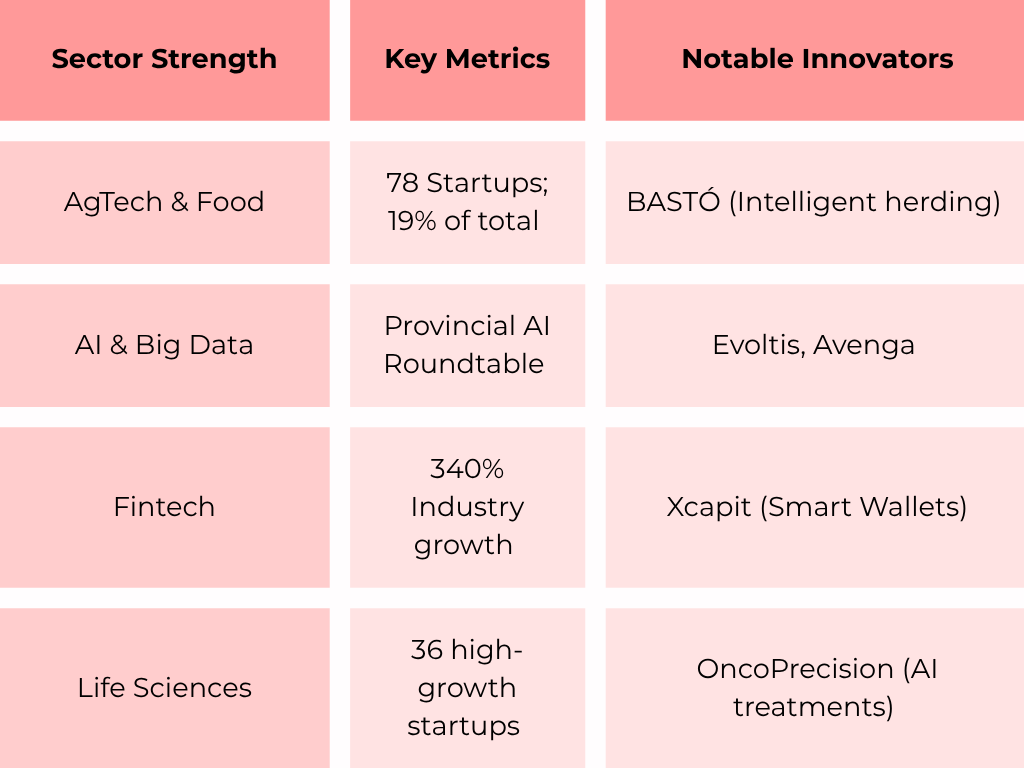
The provincial government facilitates rapid growth by allowing companies to form in just 48 hours—a policy that has attracted Silicon Valley-based accelerators like the Founder Institute to establish a local presence.
Medellín’s transformation into a regional innovation capital is the result of deliberate institutional support through Ruta N, a dedicated science and technology agency. Recognized as one of the fastest-growing ecosystems in South America, Medellín has successfully institutionalized a "social innovation" model that fuses technical training with community development.
The Pipeline and Retention Edge
Medellín’s value proposition for US companies centers on a high-performing Agile culture. Firms like Gorilla Logic have established major centers here, citing the high density of QA experts, DevOps engineers, and mobile specialists.
The city’s time zone (EST/COT) allows for full synchronous collaboration, ensuring that Medellín-based developers work the same hours as teams in New York or Miami.
Florianópolis (Floripa) is the national leader in tech contribution to GDP among Brazilian capitals, with the sector representing 25% of the local economy. Despite its smaller population, the city boasts up to ten times more startups per capita than São Paulo.
The B2B SaaS Specialization
The Floripa ecosystem is built on a foundation of knowledge-intensive, B2B-focused ventures. Regional champions like RD Station (SaaS) and Softplan (LegalTech) have established a blueprint for scalable digital business models.

The "Floripa Mais Tec" program and the Federal Institute of Santa Catarina (IFSC) ensure a constant flow of fresh talent, focusing on stacks the market actually needs, such as JavaScript, Cloud infrastructure, and data analytics.
As software architectures move toward high-performance, cloud-native environments, the demand for specialized languages has surged. Secondary hubs are outperforming larger cities in per-capita density of these niche roles.

The sustainability of these hubs is anchored by "longitudinal pipelines"—partnerships where industry needs dictate university curricula.
While cost remains a primary driver, the "True Cost of Ownership" (TCO) is where secondary hubs excel. Traditional offshore hubs often suffer from turnover rates above 40%, whereas LATAM secondary cities offer a stability dividend with much lower attrition.
Salary Benchmarks (2025-2026 Estimates)
US companies typically save 40-60% on salaries compared to domestic hires while maintaining enterprise-grade quality.
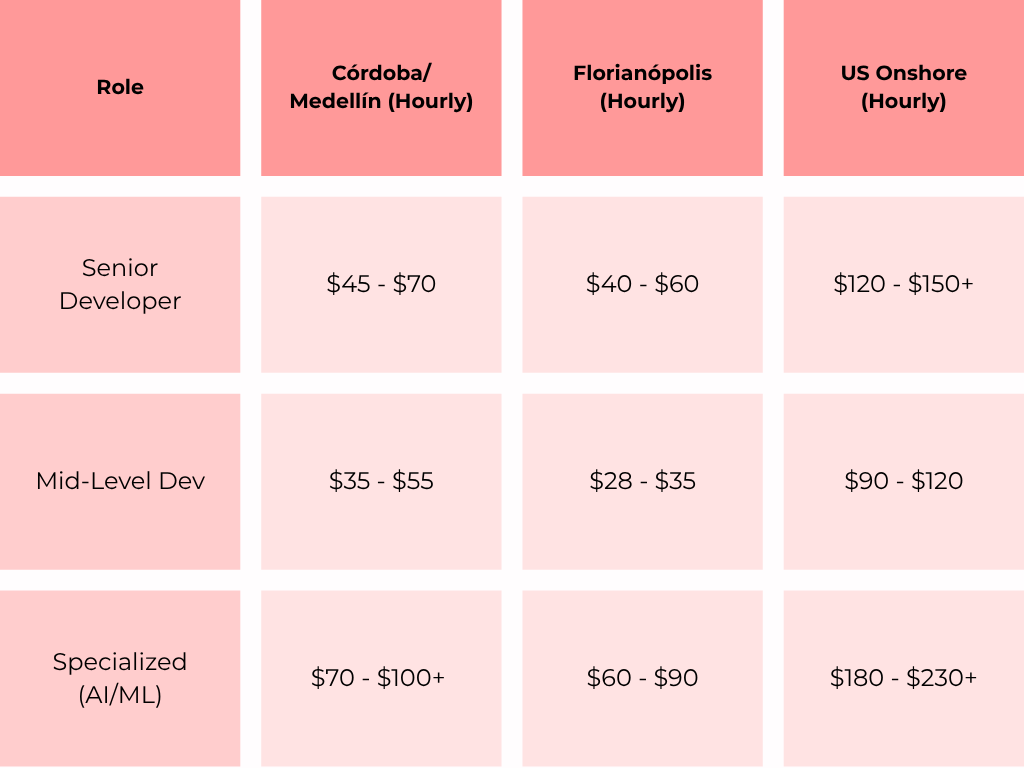
The annual developer employment cost in LATAM is approximately 53% lower than in the US. Furthermore, the synchronization with US time zones (EST/CST) eliminates the "overnight delay" common in Asian offshore models, which has been shown to increase project success rates from 60% to 80%.
If you want to learn more, check out our article on hiring costs in Latin America.
The shift toward Latin America's secondary tech cities—Córdoba, Medellín, and Florianópolis—represents a fundamental restructuring of the global engineering workforce.
These hubs offer a unique value proposition:
For US tech leaders, the strategy is clear: move beyond the megacities.
Establishing a presence in these emerging specialized hubs is not just about finding talent; it’s about securing a long-term, high-quality engineering partnership for the next decade of innovation.
If you need expert advice, please write to us. We'd be happy to help.
Learn more about nearshore software development by reading the articles from our blog!
.NET Developers
Android Developers
App Developers
AWS Developers
SQL Developers
Backend Developers
C++ Developers
DevOps Developers
Django Developers
Swift Developers
Java Developers
Node Developers
Frontend Developers
Ruby Developers
AI Developers
Full Stack Developers
Blockchain Developers
JavaScript Developers
React Native Developers
Ruby on Rails Developers
Salesforce Developers