


Cursor vs Claude Code, Codex and Copilot for Your Team
Cursor vs Claude Code, plus Codex and Copilot, compared for teams: what each agent may touch, what admins can enforce, what a seat costs, and how to review.
Read More

AI for software development is the use of language models and coding agents across the work of building software, from writing and testing code to reviewing and explaining it, while engineers stay accountable for what ships. For a team, the more useful definition is narrower: AI lowers the cost of work that repeats and leaves the cost of judgment roughly where it was. That is why the same tools make one engineering team smaller and leave another exactly the size it was.
The question usually arrives from above: with AI, does next year's plan still need the same headcount? The honest answer depends less on the tool than on the kind of work the team does. Most of what gets published is a list of tools or a productivity promise. This is the map for the person who has to decide: the forms AI takes inside a team, the problems that come with it, how to measure the effect, and what has to be true before a team gets smaller.
The argument is simple. AI shrinks an engineering team only where the work compounds. Everywhere else, it moves the bottleneck from writing code to reviewing it.
For most engineers, AI is no longer a side tool; it is part of the daily workflow. In the 2026 Stack Overflow Developer Survey, coding assistants and agents were the most common use of AI among respondents (66%), and 73% said they use them daily.
The top tasks in that survey were generating code in a familiar area, debugging and refactoring, answering straightforward technical questions and writing tests. They share one trait: the answer can be checked. The same survey found that 48% of respondents trust AI when they can easily validate its output, and only 16% extend that trust to most tasks.
For an engineering leader, adoption is no longer the decision: your engineers are very likely using AI already. The decision is where the team relies on it, who checks what it produces, and whether the work is shaped so that the gain accumulates.
AI-assisted software development is not one practice. Four forms show up inside engineering teams, and each one changes a different part of the work.
Autocomplete and chat inside the engineer's editor. It speeds up the typing part of a task the engineer already understands. Team structure and accountability stay the same.
The engineer works through a problem in conversation with the model: explaining intent, asking for alternatives, having it draft the tests. It changes how one person reasons through a task more than how much the team delivers.
Agentic coding means handing an AI coding agent a goal instead of a single instruction. The agent reads the repository, plans the change, edits several files, runs the tests and proposes the result for review. This is the ground where Claude Code, Cursor, Codex and GitHub Copilot compete, and the same Stack Overflow survey names Claude Code and GitHub Copilot as the leading coding agents among its respondents.
Because agents can complete work end to end, they also put more code in front of your reviewers and need more access to your systems. We compare the four tools from the point of view of the person who standardizes for a whole team in which AI coding tool your team should standardize on [ENLACE PENDIENTE: Claude Code, Cursor, Codex or Copilot for your team — activar cuando se publique el 20-oct].
The fourth form is a way of staffing, not a tool: an AI-augmented team that starts larger and is planned to need fewer people as the knowledge in their heads turns into artifacts the client keeps, such as prompts, evaluations, pipelines and playbooks. Our page on AI-augmented teams describes a squad that starts at, say, six people and is designed to shrink, to four and then to two. The tools are the same; what changes is that a smaller team is the goal, with a plan for getting there.
Across the software development life cycle, the gain from AI concentrates where the work is defined and checkable: implementing a known pattern, writing tests, migrating code, fixing a bug that has a clear reproduction. It thins out where the work is mostly deciding: what to build, which tradeoff the business can live with, which edge cases your customers will actually hit.
That split explains a pattern many teams notice after the first months. Code gets written faster, and the time saved reappears downstream, in review, integration and testing. The work did not disappear; it moved to the stage where a person has to judge whether the code is right. In a team that already reviews well, that is a good trade. In a team where review was already the bottleneck, AI makes the queue longer.
The benefits of AI for a software team are real, and so are four costs that productivity claims rarely mention.
Faster generation means more changes waiting for a reviewer. The 2025 DORA report on AI-assisted software development, based on survey responses from nearly 5,000 technology professionals, found a positive relationship between AI adoption and delivery throughput, and a negative one with software delivery stability. In the report's own reading, AI accelerates development, but that acceleration can expose weaknesses downstream. Unless review and testing keep up, the speed comes back as rework.
Code that runs is not the same as code that is safe. In Veracode's 2025 evaluation of AI-generated code, 45% of the samples failed security tests and introduced vulnerabilities from the OWASP Top 10. Secrets in prompts, invented dependencies and agents with more access than the task needs complete the picture. We cover the review rules in a secure SDLC for AI-written code.
AI tools are not only a seat license. Agents consume tokens, and consumption grows with the work they take on. Our AI-augmented teams page puts it plainly: "There's a token cost, and it's not zero." It is smaller than the headcount it replaces, but it is a new line in the budget and belongs in the business case from day one. Here is how to estimate and control AI token spend before the invoice arrives.
The most common disappointment is not a failure of the tools. It is a team doing one-off, exploratory work, where every task is its own problem and nothing accumulates. There, AI helps each engineer and the team stays the same size. That is a fine outcome, just not the one the budget assumed.
Measure the work, not the feeling. In a randomized study by METR, experienced open-source developers working on their own repositories took 19% longer to complete tasks when they were allowed to use early-2025 AI tools, and afterward still estimated that AI had made them 20% faster. METR describes it as a snapshot of early-2025 tools, and in a February 2026 update it said developers are likely sped up more by newer tools, though its new data is only weak evidence of how much. The lesson that lasts is about measurement: perceived speed is not a metric.
Four numbers tell you more:
AI amplifies the team it lands in. The DORA report says it directly: "AI doesn't fix a team; it amplifies what's already there." A team with clear workflows and good review gets better; a team with weak ones gets its weaknesses faster.
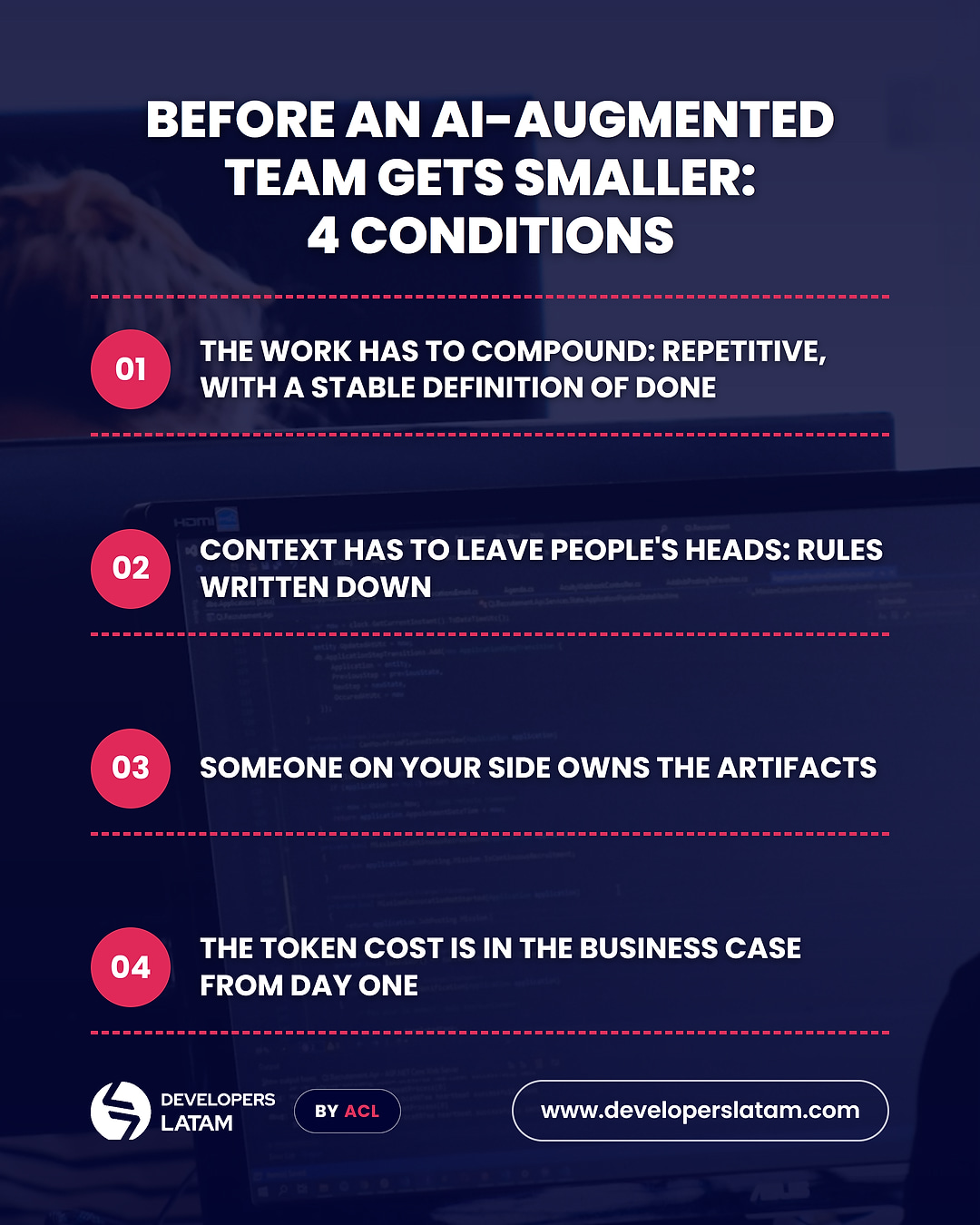
Before a team can get smaller, four conditions have to hold. Our page on AI-augmented teams lists them:
The same page names the three ways the model fails, and all three are visible early. The work turns out not to compound, and the honest move is to convert the engagement to traditional staffing instead of keeping it going. The curve stalls, because the real criteria live in one senior engineer's judgment and that person has no time to write them down. Or the artifacts lose their owner, and six months later the team quietly grows back.
There is also a limit that no artifact removes. Artifacts replace the repetition, not the people. Deciding what to build, which edge case costs you a customer and who is accountable at 3 a.m. stays with a person. That is why the page is explicit about what it does not offer: "We don't promise six-to-two, and we don't promise a date."
Not every team should aim to get smaller. If the work is mostly exploratory, if the product is changing direction, or if the gap is one skill your team doesn't have, the better move is usually to add a named engineer who works inside your process. That is staff augmentation for a specific role: a defined skill, a start date, and your team directing the work. Before opening the search, it is worth asking whether you still need to fill that role as it was written.
AI still matters on that path, as a tool the engineer uses well inside your standups, your tools and your review. That is how our engineers work once they join a client's team. And the two paths are not exclusive: a team can start with one and move to the other when the shape of the work changes.
The tool debate is the easy part, and its answer will be different next quarter. The decision that lasts is about the work: which parts repeat, who writes down the rules, who owns what gets built and who reviews what the AI produces. Where the work compounds, a smaller team is a realistic goal. Where it doesn't, plan for AI to make good engineers more effective, and budget for the review that comes with it. If you want to look at a specific team or position together, talk to us about it.
Agentic coding is a way of working in which an AI coding agent receives a goal rather than a single instruction, then plans and carries out the change: it reads the code, edits files, runs tests and proposes the result. An engineer sets the goal, limits what the agent can access and reviews the result before it ships.
On defined, checkable tasks it often does. On complex work in a large codebase the developer already knows well, a randomized study found experienced developers were slower with early-2025 tools while believing they were faster. Cost per unit of work and delivery stability are better guides than perceived speed.
Our page on who legally employs them describes the model this way:
«Staffing with employment included. The partner finds the person and employs them. […] This is what we do.»
And it sets out where the line falls:
«Transfers to us: The employment contract · payroll and social contributions · statutory benefits and leave · compliance with local labor law · the administrative side of hiring, changing and ending the relationship.»
«Stays with you: Direction of the technical work · who does what and when · access to your systems and data, and the governance of that access · and the decision about who joins your team.»
Learn more about nearshore software development by reading the articles from our blog!


