


Why AI engineers are hard to hire, and what helps
When an AI engineering search runs five months, the instinct is to fix the process. Usually the problem is the profile, and it calls for a different approach.
Read More


Hiring an AI developer in Latin America means finding an engineer who has already connected models and agents to systems in production, and bringing that person onto your team from a region that shares your working hours. The region is where you look. The real constraint is the profile: engineers who have shipped AI into production, and watched it fail, are scarce in every market, including this one.
Most advice about hiring AI developers in Latin America leads with price. That framing misses what actually stalls these searches. The problem is rarely the budget. It is that the role stays open for months, the candidates who interview well turn out to have read about AI rather than built with it, and the partner who promised the profile can't produce it.
This guide covers why the AI profile is scarce, what the region's AI ecosystem looks like in 2026, which of the three profiles you actually need, how to run the hire, and how to check that a partner can reach the person before you sign.
The AI profile is scarce because demand moved faster than experience. Nearly every engineering team now works with AI tools, but only a small group of engineers has spent years making models behave inside real systems. That group is contested globally, and Latin America is part of the same market.
The demand side is visible in the Stack Overflow 2025 Developer Survey: 84% of respondents use or plan to use AI tools in their development process, up from 76% the year before. Using a tool is not the same as building with it. Every company that adopts AI eventually needs someone who can integrate it, evaluate it and keep it running, and that person is the one nobody can find.
The supply side is visible in the region's own data. The Latin American Artificial Intelligence Index (ILIA 2025) reports that a shortage of advanced training and the emigration of specialists continue to widen the gap with the global average in human capital. In other words, the most experienced AI engineers in the region are already in demand, and some of them have left.
As DevLatam's page on AI, security and data puts it: "AI didn't remove the need for engineers. It concentrated it." Companies hire fewer people, and the ones they do hire are harder to find and more expensive to get wrong. Looking in Latin America widens the pool. It doesn't make the profile common.
Latin America's AI ecosystem is uneven but real. The ILIA 2025 evaluates 19 countries and places Chile, Brazil and Uruguay as "pioneers," with scores above 60 points and a lead in infrastructure, talent and innovation. The index is produced by Chile's National Center for Artificial Intelligence and the UN's Economic Commission for Latin America and the Caribbean.
Brazil shows the same pattern at country level. Its national technology industry association, Brasscom, names AI and machine learning specialists, data analysts and scientists, and information security analysts among the most important professions for the coming years, and reports that the market needed 665,403 tech professionals between 2019 and 2024, while only 464,569 graduated between 2018 and 2023.
The hubs are the ones you'd expect: São Paulo, Mexico City, Buenos Aires, Santiago, Montevideo and Bogotá, each with university programs, research groups and engineering communities working with tools such as PyTorch, TensorFlow and scikit-learn. For a hiring team, the takeaway is practical. The engineers exist, they are concentrated in a few markets, and the strongest of them have options.
Before you search, decide which of three profiles you are actually missing. Teams often post an "AI developer" role when the gap is in data or in security, and the search fails because it is looking for the wrong person.
If your prototype works but nobody trusts its answers, you probably need data before more AI engineering. If legal or compliance is blocking adoption, you probably need security. The guide to what an AI developer does describes each profile's day-to-day in more depth.
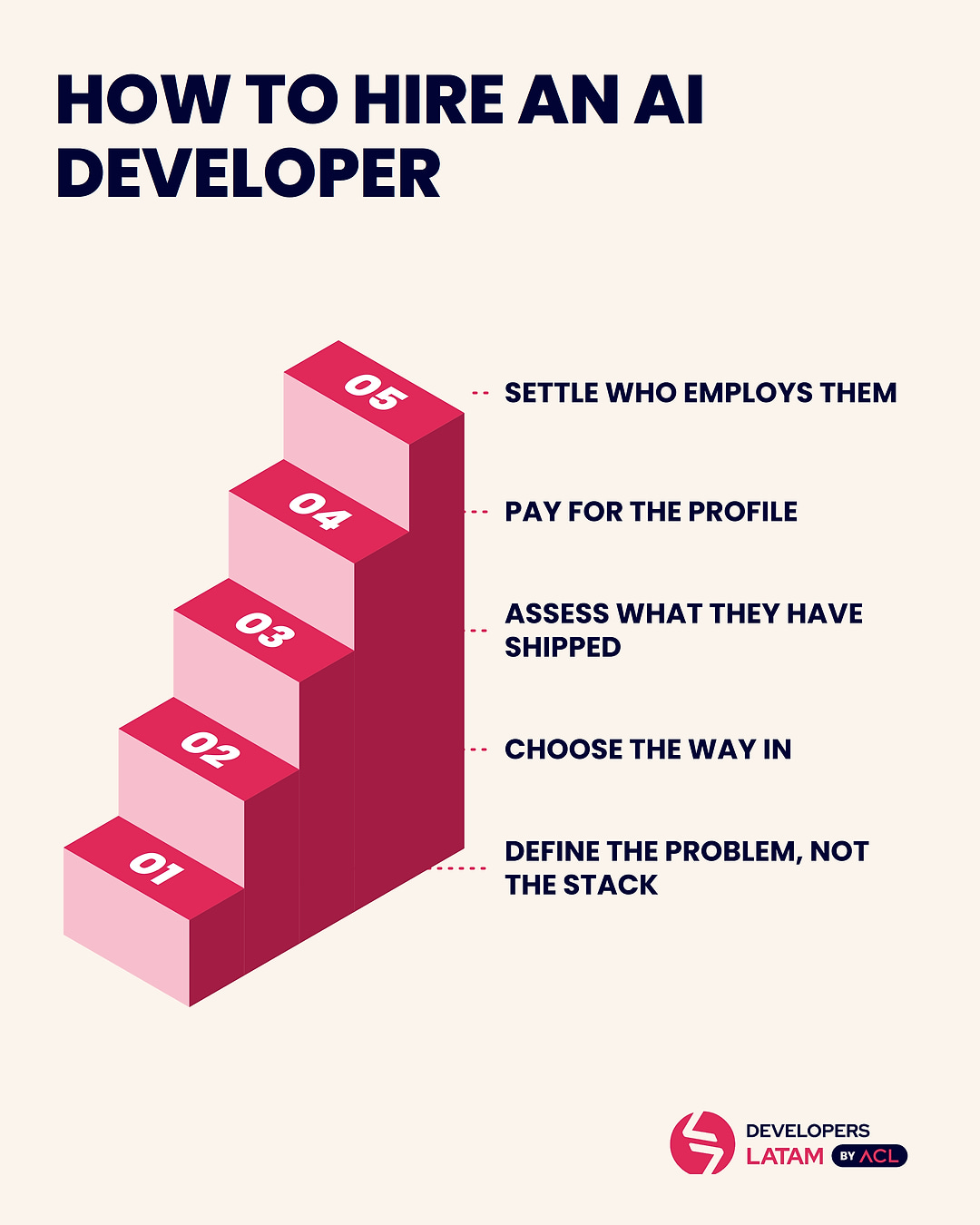
Hiring an AI developer in the region takes five steps. The first and the third decide most of the outcome.
Write down what the role has to deliver in six months, what it integrates with and who it reports to. "Experience with LLMs" is not a requirement; "make the support agent answer from our policy documents without inventing refunds" is.
There are three ways to bring the engineer onto your team: one named role through staff augmentation, an AI-augmented team designed to shrink as the work is captured in artifacts, or an engagement with part of the fee tied to results. The page on ways to fill the role compares them with hiring directly and using an employer of record.
The vocabulary of AI engineering is easy to acquire and hard to tell apart from experience. Someone who has read carefully often interviews better than someone who shipped a system and mostly remembers what went wrong. Ask candidates to walk through something they built: the constraint, what they chose, how they evaluated it, what broke. The guide on how to interview AI developers has the questions.
Research current compensation for the specific profile and seniority. Senior AI engineers in the region compare offers from companies around the world, and an offer built around a discount loses to the first serious counteroffer.
Someone has to be the engineer's legal employer in their country. With DevLatam, the home page answers it directly: "We are their legal employer. Payroll, compliance and employment obligations sit with us, in the country where they live." What transfers and what stays with you is on the page who legally employs them. The direction of the work, and the decision about what data the engineer and the models can reach, stay with your team.
Any partner can list AI as a specialty. Before you sign, ask for evidence. These are the four questions DevLatam publishes on its AI, security and data page, and they work with any provider:
Ask for the answers in writing. A partner that is specific about what it can't do is easier to work with than one that is vague about covering everything. The guide to choosing a software development partner covers the rest of the evaluation, and How DevLatam works shows how its own technical review is done: by engineers who do the work, with reservations about each candidate stated up front.
The first months decide whether the hire pays off, and most of what decides them sits on your side. An AI engineer needs reach into the systems that matter: repositories, data, the environments where models run. That reach is the job, not a concession. But someone in your organization has to own the decision about what it includes, what it excludes, and who reviews it when the work changes shape a few months in. A staffing partner can't own that decision for you.
Plan three things before the start date:
It also helps when the engineer arrives with a method. DevLatam's engineers bring the engineering frameworks and playbooks of the ACL and DataArt group: how code gets reviewed, how access is granted, how data is handled. In the site's words, the result is that "the first pull request looks like the tenth." The method comes with the person and doesn't replace your practices; the engineer still follows your review standards.
Compensation follows the profile more than the country, so a lower salary is possible but not guaranteed. Senior AI engineers in the region compare offers from companies around the world. The better comparison is the total cost of the position, including the months it stays open and the cost of a hire who doesn't work out.
It depends on the profile, the seniority and how fast your team interviews. Scarce AI profiles take longer, and, in DevLatam's experience, a week without an answer is the most common way to lose a good candidate. Ask any partner for a time estimate for your specific role before you start, and ask what would make it longer.
Yes, and you should. With DevLatam, you interview whoever you want, and nobody joins your team without your yes. Ask candidates to walk through something they built: the constraint, what they chose, how they evaluated it and what broke. People who have shipped AI answer with specifics; people who have only read about it don't.
It depends on where the bottleneck is. If it is integrating models into production, you need AI engineering. If it is untrusted data or blocked adoption, a data or security engineer may unblock more. Deciding that before the search starts saves months of looking for the wrong person.
Latin America widens the pool for AI engineering, data and security, and its working hours make the engineer part of your day. It doesn't make the profile common. The hires that work start with a clear problem, an assessment of what the person has shipped, and a partner that can prove it reaches the profile. To describe the role you can't fill, start with AI, security and data. For other roles in the region, see the guide to hiring LATAM developers.
Learn more about nearshore software development by reading the articles from our blog!


