AI for Software Development: What Changes for Your Team
AI for software development shrinks a team only where the work repeats. The forms it takes, the costs it adds, how to measure it, and what has to be true first.
Read More


Hiring remote developers in Chile means adding an engineer who lives and works in Chile to a team based elsewhere, usually in North America, with most of the working day in common and the work directed by that team. The engineer is employed in Chile; the work happens in your repository, your standups and your priorities. It is a way to fill a role that has stayed open too long because the profile is scarce at home, especially in AI and data.
Chile has a reputation as one of the most stable markets in Latin America, with strong universities and a public push for digital skills. It is also one of the region's leaders in artificial intelligence, by the measure the region itself uses. This guide covers the tech market, the skills to look for, what a position really costs, and the three ways to bring that person onto your team.
Companies hire remote developers in Chile for the depth of its tech talent, its standing in AI, working hours that overlap with the US East Coast and an economy that rewards long-term planning. The case is about reaching profiles that are hard to find, not about paying less.
Chilean universities such as the Pontifical Catholic University of Chile and the University of Chile are among the best known in the region for computer science and engineering. Chilean developers work across industries, including finance, mining, retail, healthcare and logistics, so it is often possible to find engineers who already know your domain.
The government and private companies run Talento Digital para Chile, a program that trains people in digital skills through intensive courses. According to Chile's Ministry of Finance, the program has managed more than 30,000 scholarships since 2019 and plans to expand its coverage to 50,000 people in the coming years. The program mostly adds junior talent; senior profiles still come from years of industry work.
Mainland Chile runs on UTC-4 in winter and UTC-3 in summer. Depending on the season, Santiago is on the same clock as New York or one to two hours ahead of it, which leaves most of the business day in common with the US East Coast and a good part of it with the West Coast. Code reviews and standups happen in real time.
Chile has one of the highest GDPs per capita in South America and a long record of economic stability. For a hiring company, stability means fewer surprises over the life of a long engagement, which matters more than any single hiring cost.
Chile's software development market is concentrated in Santiago, which hosts most of the country's tech companies, startups and the local offices of global firms such as Microsoft, IBM and Oracle. Public programs have helped the ecosystem grow: Start-Up Chile, run by the national development agency, has drawn founders from around the world for more than a decade.
The market is also known for applied AI. Chilean companies such as NotCo, which uses machine learning to develop plant-based food, show that AI work in Chile goes beyond research into products that ship. For a company hiring engineers, that means a local market with real experience putting models into production.
Chile sits at the top tier of the region in artificial intelligence. The Latin American Artificial Intelligence Index, prepared by Chile's National Center for Artificial Intelligence with ECLAC, places Chile, Brazil and Uruguay as the region's pioneers, with scores above 60 points out of 100. The same report warns that advanced AI training is concentrated in a few countries and that specialists keep leaving the region, so senior AI engineers are scarce even in Chile.
Beyond AI, Chilean developers cover the stacks most teams run on: Python and Java, cloud platforms such as AWS and Azure, and agile practices like Scrum and Kanban. What to look for depends on the profile:
Engineers who connect models and agents to systems already in production, evaluate their output and keep them running after the demo. Ask for something they shipped and what failed after launch, not for a list of courses.
Pipelines, data quality and lineage, the layer every AI project depends on. Chile's mining, retail and financial companies run large data operations, which makes this a reachable profile.
Access and data governance around AI systems, and review of what a new capability exposes. Look for engineers who ask what a tool is allowed to read before connecting it, and who treat generated code with the same review as any other.
Many Chilean developers have worked for North American and European companies or for the local offices of global firms. That experience shows in how they document, raise problems and work with distributed teams.
Chilean engineers usually know agile methods well. The point to confirm is that they adapt to your review standards and definition of done, rather than bringing a parallel process.
The page on AI, security and data profiles lists four questions to ask any partner who claims to reach these profiles, starting with "Where have they placed this exact profile, and when?".
English in Chile is moderate at the national level and stronger among engineers who work with international teams. In the latest EF English Proficiency Index, Chile ranks 54th globally with a score of 517, above the global average of 488. Graduates of the top universities often studied and worked in English, but the level varies widely by person, so confirm it in the interview with a technical conversation.
Business culture is formal at first and direct once trust is built. Chilean developers used to international teams take part in meetings, write documentation and raise problems in English. Clear expectations at the start, set in writing, help more than any cultural briefing.
The salary is the starting point, not the total cost of a position. Salaries vary by city, seniority and specialty, and senior AI, data and security profiles are priced by a market where international companies compete for the same people.
A full picture adds employment costs in Chile, the time your team spends interviewing and onboarding, the tools the engineer needs and, if the team works with AI, the cost of those tools and their tokens. Keep in mind that working through a partner, whether an employer of record, a staffing company or a hiring platform, costs more than the salary alone, because the rate includes employment, payroll and, in some cases, the search. The comparison that matters is the total cost of having the right person working in your team, including the weeks the role stays open while you look.
Seniority changes both the cost and what the person can take on, so decide which level the role really needs before comparing offers.
Three problems show up in Chilean searches often enough to plan for them from the start.
The first is the counteroffer: a strong engineer accepts, resigns, and their current employer improves the offer. It is most common with senior and AI profiles, the same ones international companies in Santiago are competing for. Keep a second candidate warm until the start date.
The second is a role that changes mid-search because the roadmap did. It is normal, but it resets part of the search, so agree on the new profile before interviews continue.
The third is a slow interview panel. A week without an answer is the most common reason a good candidate takes another offer. If your team can't interview for two weeks, start the search when it can.
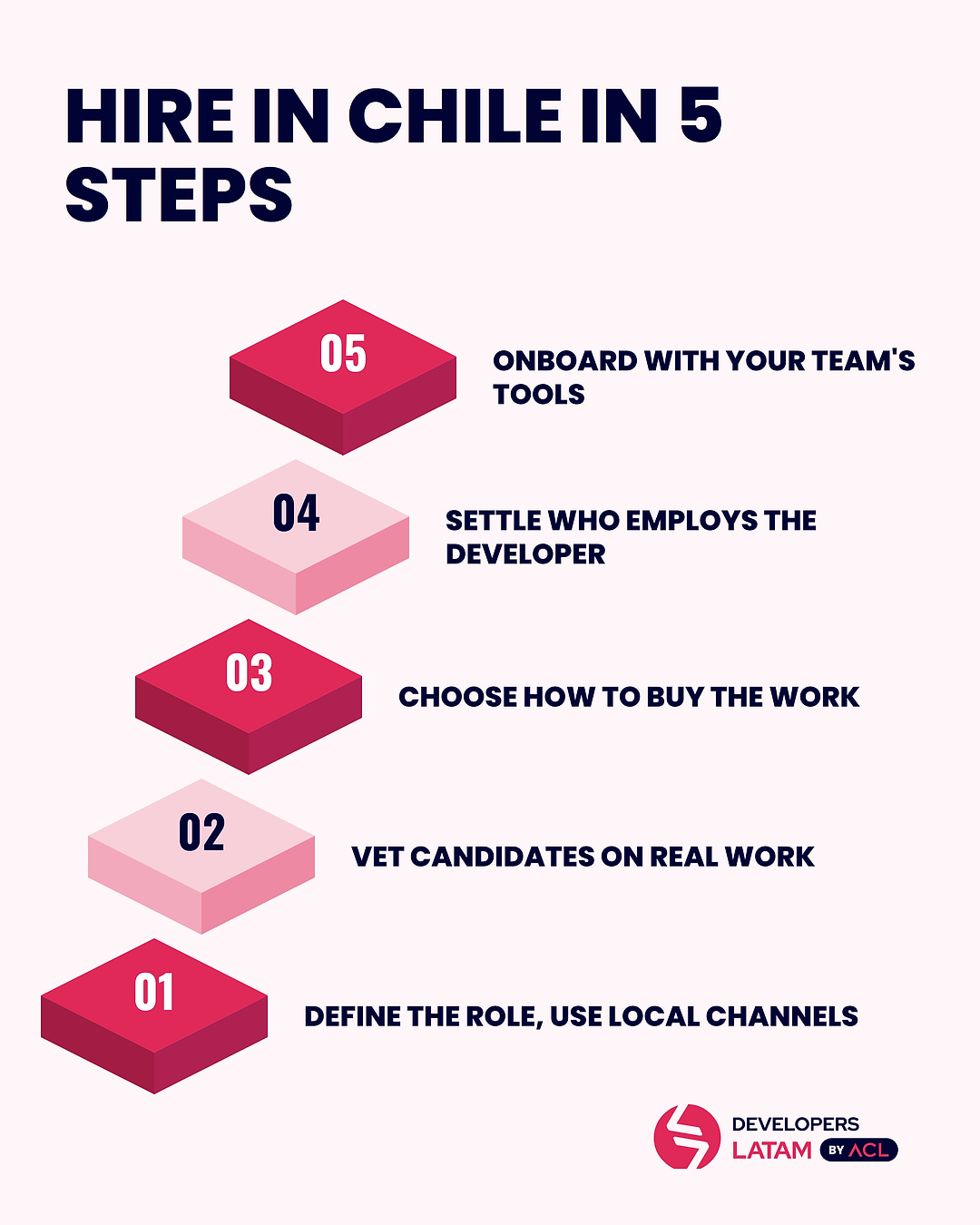
To hire a remote developer in Chile, define the role, choose a channel that matches how scarce the profile is, assess the person on real work, and settle who employs them before the start date.
Write down what the role has to do, what it integrates with, who it reports to and what success looks like in six months. Then use the channels Chilean developers actually use: local job boards such as Get on Board and ChileTrabajos, LinkedIn for mid-level and senior profiles, and tech communities and meetups in Santiago. These channels reach candidates, but the screening, employment and payroll remain on your side.
Screen candidates on real work. Tools such as HackerRank or Codility measure coding skills, but not what usually fails: holding an unfamiliar system in one's head and acting well when the spec is ambiguous. Ask candidates to walk through something they built, what the constraint was and what they would do differently. Check references with teams that worked with them remotely.
DevLatam offers three ways in. "The engineers and the employment model are the same in all three. What changes is how you buy, and how the risk is shared":
The employment question has a one-line answer: "We are their legal employer. Payroll, compliance and employment obligations sit with us, in the country where they live." The page on who legally employs them explains what transfers and what stays with your company.
Give the new engineer access to your tools on day one, whether that is Slack, Zoom or Microsoft Teams, introduce them to the team and set clear expectations for the first weeks. Regular check-ins early on catch problems while they are still small. You interview whoever you want, and nobody joins your team without your yes.
Start-Up Chile is the startup program of Corfo, Chile's national development agency, created in 2010 to bring global talent to the country. According to its own site, more than 3,000 startups have gone through its programs. For a hiring company, it is part of why Santiago has an active startup scene alongside the offices of global firms.
Several large US tech companies operate in Chile, and Amazon Web Services made its largest commitment in the country to date: according to InvestChile, AWS announced a US$4 billion investment over 15 years to build three data centers in Santiago. Microsoft, IBM and Oracle also have local offices, and they compete with you for senior engineers.
Freelance developers in Chile can be found on global freelance platforms, on local job boards such as Get on Board, and through LinkedIn and Santiago's tech communities. Freelancers work well for short, well-defined tasks. For a role that stays in your team for a year or more, screening, continuity and payroll all stay on your side.
Chile gives you strong universities, a place among the region's AI leaders and working hours close to the US East Coast. The hiring works when it starts from the role and the total cost, and when AI experience is checked against work the person actually shipped.
For the wider picture across the region, read the guide on how to hire LATAM developers. When you know the skill and can't find the person, see how DevLatam can fill the position, or talk to us about a position.
Learn more about nearshore software development by reading the articles from our blog!